


Writing Practice for Preschoolers Without Pressure
Learning to make marks should not feel like a test. The best writing practice for preschoolers begins with comfort, curiosity, and permission to stop. When parents focus on small movements instead of perfect letters, children can build useful skills at a pace that feels manageable. A wobbly line is not a mistake; it is evidence that a young hand is learning.
Explore Grooved Learning's reusable grooved workbooks for calm, guided practice.
Between ages three and five, children develop at very different rates. One child may eagerly copy a name, while another prefers drawing circles or squeezing clay. Both can be making meaningful progress. The goal is to offer suitable activities, notice signs of fatigue, and help each child connect writing with confidence rather than pressure.
What does writing practice for preschoolers look like?
Preschool writing readiness is a combination of fine motor control, visual attention, interest, and comfort using a tool. A ready child may enjoy scribbling, copy a basic line, or stay with a simple tracing activity for a few minutes. Perfect grip, neat letters, and long practice sessions are not required.
Writing depends on more than fingers. A child uses the shoulder to steady the arm, the wrist to position the hand, and the small muscles of the fingers to guide a crayon or pencil. Core stability also helps a child sit comfortably. When any part of this system is still developing, a writing task can feel tiring even when the child understands what to do.
Fine motor readiness comes before neat letters
Look for everyday signs of growing control. Turning board-book pages, stacking small blocks, opening containers, placing pegs, and pinching pieces of dough all exercise movements used in writing. A child who can make deliberate marks and release small objects with care is building a useful foundation. There is no need to insist on a mature pencil grip before the hand is ready.
Large movement can support small movement. Drawing on an easel, painting a fence with water, or making giant chalk paths gives the shoulder and wrist room to work. These activities often feel easier than sitting at a table. Later, the same child can bring those familiar motions onto a smaller page.
Start with pre-writing strokes
Letters are combinations of simpler movements. Vertical and horizontal lines, circles, curves, crosses, and diagonal lines give children a practical movement vocabulary. Practice one kind of stroke at a time, then combine familiar strokes into shapes and letters when the child shows interest.
A parent might draw a road for a toy car, invite a child to add rain beneath a cloud, or make circles around stickers. These playful prompts give each stroke a purpose. Grooved Learning's guide to pre-writing tracing worksheets offers more ideas for building the movements that come before handwriting.
Notice comfort, not just output
A child who is ready to continue usually looks relaxed, experiments willingly, and recovers easily when a mark goes off course. Tight shoulders, a very hard grip, repeated hand switching caused by fatigue, or growing frustration can mean it is time for a break. Calmly ending a session protects the child's willingness to return.
Parents do not need to correct every stroke. Try describing what happened instead: "You made a long line from top to bottom." Specific observations help a child notice movement without turning practice into a judgment. Praise patience, attention, and trying again rather than calling one page good and another bad.
Age 3, 4, and 5 writing expectations
Expectations should be flexible because preschool development is not a race. At three, many children explore scribbles and basic strokes. At four, some begin copying shapes or familiar letters. At five, many can attempt a name and simple words. Interest, control, and confidence are more informative than a fixed checklist.
Age ranges can help parents choose an activity, but they should not become deadlines. Experience, language development, hand strength, and individual needs all affect what a child finds comfortable. Offer the next small challenge, then step back if it causes strain.
- Age 3: Explore tools, scribbles, broad lines, and circles through chalk, sand, and free drawing.
- Age 4: Copy simple shapes and try familiar letters with a nearby model and no demand for a perfect match.
- Age 5: Attempt a name, numbers, and short familiar words through useful tasks such as cards, labels, and lists.
Writing activities for age 3
For many 3-year-olds, the most useful practice is exploration. Thick crayons, washable markers, play dough, and large drawing surfaces are easier to control than thin pencils. Invite broad marks without asking for recognizable letters. A few minutes of happy scribbling can do more for readiness than a long tracing page completed through frustration.
Writing activities for age 4
Many 4-year-olds enjoy copying shapes, tracing paths, and recognizing the first letter in their name. Keep the model simple and nearby. If a child asks how to make a letter, demonstrate slowly and let the child try. If the attempt becomes a different shape, stay neutral and appreciate the effort.
Writing activities for age 5
Many 5-year-olds are ready to attempt their name, numbers, and a few familiar words, but neatness still varies. Give writing a real purpose: sign a picture, label a toy box, write a short card, or count objects on paper. Meaningful tasks show why marks matter while leaving room for developing control.
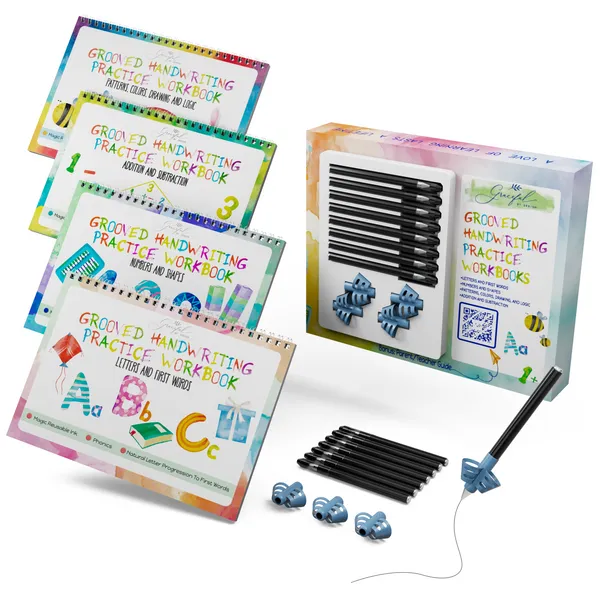
Grooved Learning's Early Learning books extend beyond handwriting drills. The reusable activities cover letters, first words, numbers, shapes, patterns, logic, and beginner math. That range lets parents follow a child's interests and alternate pencil movement with thinking activities, rather than repeating the same task until it feels stale.
Browse Grooved Learning's writing collection to find an age-appropriate next step.
How can parents make practice calm and effective?
Keep practice brief, predictable, and playful. Choose one small goal, offer a comfortable tool, and stop before fatigue turns into frustration. Mix guided tracing with sensory play and free drawing. A child who feels safe making imperfect marks is more likely to return, experiment, and build steady control over time.
Use a five-minute routine
A routine can be simple enough to repeat without becoming rigid. Begin with one minute of hand warm-up, such as squeezing dough or opening and closing clothespins. Spend two or three minutes on a stroke, shape, letter, or number. End with free drawing or a choice activity. Put the materials away while the experience still feels positive.
Choose a time when the child is rested and not hungry. Keep supplies in one easy-to-reach place, and let the child select between two reasonable options. "Would you like to make circle bubbles or straight rain lines?" gives useful control without creating an overwhelming choice. If the answer is neither, try another day.
Set up the space for comfort rather than formality. A child-sized table can help, but writing on the floor, at an easel, or outside may suit some activities better. Offer a thick crayon or marker that is easy to hold. Keep the page steady, leave enough room for the arm to move, and remove extra materials that may distract from the chosen task.
Repetition does not have to mean repeating an identical page. Practice a curved movement by tracing a path, drawing waves, making dough snakes, and then trying a letter with a similar curve. The movement stays familiar while the purpose changes. This approach gives the hand several chances to learn without making the routine feel like a drill.
Let sensory feedback guide the hand
Sensory feedback is information a child receives through touch and movement. A finger tracing a shape in sand feels resistance. A crayon on textured paper creates vibration. A pen moving through a groove meets a physical boundary. These sensations can make a stroke path easier to notice than a visual line alone.
Grooved pages can provide a guided route while the child learns a movement. Plain paper remains valuable for free drawing and independent control. Moving between both formats helps a child experience support and exploration. Grooved Learning's reusable books pair tactile paths with ink that fades, so the page can be used again without preserving every early attempt.
| Practice surface. | Feedback. | Best use. |
|---|---|---|
| Sand, dough, or finger paint. | Strong touch and movement feedback. | Large, playful pre-writing strokes. |
| Grooved page. | Tactile boundary plus visual path. | Guided repetition of a specific movement. |
| Plain paper. | Mainly visual feedback. | Free drawing and independent practice. |
Build confidence without empty praise
Confidence grows when children see that effort leads to greater comfort, not when adults promise that every mark is perfect. Use calm, specific language: "You kept your pencil moving around the curve," or "You noticed the line and tried again." This directs attention to a useful action the child can repeat.
Avoid erasing or correcting without permission. Ask, "Would you like help, a new page, or to keep it as it is?" The choice communicates that early attempts are expected. Reusable materials can also lower the stakes because practice does not have to become a permanent record.
Respond gently when a child resists
Resistance often means the task is too hard, too long, or poorly timed. It does not mean a child is lazy or unable to learn. Step back to an easier movement or switch to a hand-strength game. A reluctant writer may happily use tongs, spray water, build with small blocks, or draw a maze for a toy.
Parents can also connect practice to a child's interests. Make curved dinosaur tails, straight train tracks, patterned decorations, or number labels for pretend shopping. If a child frequently avoids fine motor tasks, appears to be in pain, or struggles well beyond what a parent expects, an appropriate health or education professional can help assess the situation.
A practical path from strokes to early learning
A balanced path moves from hand-strength play to pre-writing strokes, guided tracing, and meaningful independent marks. Children do not need to master one stage before touching the next. Parents can move forward or back according to comfort, using letters, numbers, shapes, patterns, logic, and beginner math to keep learning varied.
Begin with what the child can already do. If circles are comfortable, try a simple pattern of large and small circles. If straight lines are easier, use them to make a ladder, square, or simple letter. Connecting a new task to a familiar motion gives the child a clear starting point.
Then add meaning. A line can become part of a shape, a shape can become a picture, and a letter can become part of a name or first word. Numbers can label a group of objects. Patterns and logic activities build careful looking and sequencing, while beginner math gives children a reason to make marks and count. This variety keeps writing connected to broader early learning.
Rotate the focus across the week instead of trying to cover everything in one sitting. One day might center on lines and shapes; another might use numbers during pretend shopping; a third might pair a first word with a drawing. Returning to a skill after a break can show parents what feels easier and what still needs gentle support.
For children interested in their names, Grooved Learning's overview of free name writing worksheets can help parents choose and use name practice thoughtfully. A name is meaningful, but it can also be complex. Practice one part at a time and return to easier strokes whenever needed.
See Grooved Learning's flagship reusable workbook set for guided Early Learning activities.
The most sustainable plan is the one a family can use calmly. Some days may include a complete activity; others may include only one line or a few minutes of drawing. Progress can look like a looser grip, longer attention, more willingness to try, or greater control. None of those changes needs to happen on a fixed schedule.
Frequently asked questions about preschool writing
How long should a preschooler practice writing?
Start with about five minutes and stop sooner if your child becomes tired, tense, or frustrated. A brief, pleasant routine is more useful than finishing a page under pressure. As comfort and interest grow, some children may enjoy practicing for up to ten minutes.
Should a 3-year-old be able to write letters?
Not necessarily. Many 3-year-olds are still building the strength and coordination needed to control a crayon or pencil. Scribbling, making broad lines, drawing simple circles, and enjoying hands-on play are useful foundations. Interest and comfort matter more than forming recognizable letters at this age.
What should I do if my preschooler avoids writing?
Pause formal practice and return to playful hand activities, such as clay, tongs, sidewalk chalk, or drawing in sand. Offer a choice of tools and keep the invitation relaxed. If writing or other fine motor tasks remain unusually difficult or upsetting, discuss the concern with an appropriate professional.
Are grooved workbooks better than plain paper?
The two tools support different needs. Grooved pages provide tactile boundaries that can help a child feel a stroke path, while plain paper allows freer drawing and independent control. Using both can give preschoolers guided practice as well as room to explore marks on their own.
Writing practice for preschoolers works best when it protects curiosity. With short routines, useful sensory feedback, varied Early Learning activities, and realistic expectations, parents can support developing hands without turning each mark into a measure of success. Keep the invitation warm, notice small changes, and let confidence grow alongside skill.

Written by
Jenna ColemanJenna Coleman is the founder of Grooved Learning, a former classroom teacher, M.Ed., and mom of three based in Pennsylvania. She creates hands-on, multi-sensory educational tools grounded in the Science of Reading. Every article is written from real classroom and parenting experience.
Learn more about Jenna →


