


Six Syllable Types: A Clear Guide for Families
Young readers often stumble when they find long words without a clear plan. Mastering the six syllable types gives children the map they need to read with ease. Grooved Learning supports this journey with tools that turn hard rules into simple wins.
See how Grooved Learning's Code Breakers workbooks help students master reading today.
Parents often wonder how to explain these rules without making things too hard for their kids. Learning to spot each pattern is the first step toward building a confident reader who can handle unfamiliar text.
The six syllable types at a glance
The six syllable types are closed, open, vowel-consonant-e, vowel team, r-controlled, and consonant-le. Each pattern gives a reader useful information about a vowel sound. Children can use these groups to break longer words into smaller, readable parts. With practice, syllable types support more confident decoding and spelling.
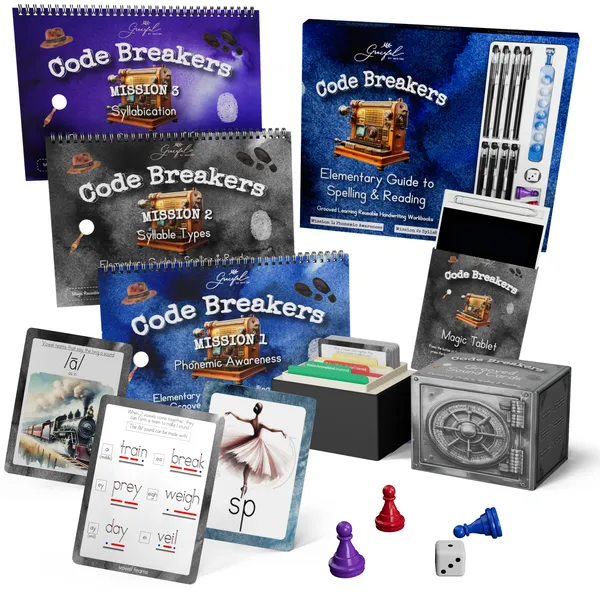
A syllable is a part of a word that you make with one push of breath. Each syllable must have at least one vowel sound to form. Learning the six syllable types helps kids find the right vowel sound and read long words with ease.
Grooved Learning's Code Breakers workbooks help kids master these patterns through hands-on practice.
How syllables help with reading
When kids can find a syllable type, they know if a vowel is long or short. This skill is a key part of reading and spelling success for new learners. It lets them break big words into small parts that they can say out loud.
Recognizing these patterns makes decoding much faster. A student who knows syllable rules does not have to guess at new words. Experts at the University of North Alabama show that the sound a vowel makes depends on the type of syllable it is in.
The six types in a scannable table
Use the table below to see the pattern and sound for each type. These six primary types play a big role in how kids learn to read and write. Each type has a specific look that tells the reader how to say the word.
| Syllable Type | Pattern | Vowel Sound | Examples |
|---|---|---|---|
| Closed | Vowel then consonants | Short | cat, dish, lunch |
| Open | Ends in one vowel | Long | me, go, sky |
| Silent E | Vowel-consonant-e | Long | cake, rope, kite |
| Vowel Team | Two vowels together | One sound | rain, boat, cloud |
| R-Controlled | Vowel then "r" | Changes sound | car, bird, fern |
| Consonant-le | Consonant then "le" | "ul" sound | table, apple, bubble |
Using Grooved Learning's Code Breakers curriculum can help students track their progress. These tools use multi-sensory steps to help kids remember each pattern and sound. This structured way of teaching is a top choice for parents who teach at home.
Start with closed, open, and vowel-consonant-e syllables
The first three of the six syllable types teach children how vowel placement changes the sounds we hear in words. A closed syllable ends in a consonant and has a short vowel sound. An open syllable ends in a single vowel that makes its long sound. A vowel-consonant-e syllable uses a silent "e" to stretch the first vowel sound.
Check out Grooved Learning's step-by-step phonics tools to help your child master these patterns with hands-on practice.
Learning to read can feel like a big job for a young child. But most English words follow clear rules that make sense once you know what to look for. By starting with these three patterns, you give your student the keys to read thousands of words. Grooved Learning's tools focus on these basics to build a strong base for future reading.
Finding closed syllables
A closed syllable is the most common pattern in the English language. In this type, a single vowel is followed by one or more consonants. The consonants "close" the vowel in, which makes it say its short sound. Think of the word "cat" or the first part of "napkin." You can see the consonant at the end acts like a door that keeps the vowel short.
Based on research from the University of North Alabama, these syllables must have only one vowel to follow the rule. If your child sees two vowels side by side, the rule changes. When you practice at home, ask your child to find the vowel first. Then, look to the right. If there is a consonant after it, the vowel is usually short. This simple check builds trust and helps kids stop guessing at new words.
Rules for open syllables
Open syllables work in a different way. In an open syllable, the vowel is not closed in by a consonant. It stands alone at the end of the word or syllable. This spot tells the vowel to say its long sound, or its name. You can hear this in words like "go," "me," and "hi." It also happens in the first part of longer words like "tiger" or "baby."
Children often get mixed up between open and closed types at first. You can help by using a "door" clue. When the door is open, the vowel can shout its name. When the door is shut by a consonant, the vowel must stay quiet and short. Grooved Learning's materials use these kinds of visual clues to make the rules stick. Using simple tools can also help children track these sounds during their daily lessons.
The silent e pattern
The vowel-consonant-e pattern is often called the "silent e" or "magic e" rule. This type of syllable has one vowel, followed by one consonant, and then an "e" at the very end. The "e" does not make a sound. Instead, it reaches back over the consonant to make the first vowel say its long name. This turns "cap" into "cape" and "bit" into "bite." You also see this in the last part of words like "pancake."
This rule is a major step in reading and spelling success for most students. It teaches them that letters can work as a team even when they are not side by side. One common mistake is when children try to sound out the "e" at the end of the word. You can remind them that the "e" is a helper that stays quiet while it does its job. Keeping the tone light and calm helps children feel safe while they learn these shifts in sound.
Add vowel team, r-controlled, and consonant-le syllables
The next three types of syllables help children decode longer, more complex words. Mastering these patterns allows students to move past simple one-syllable words and build reading confidence. By learning vowel teams, r-controlled sounds, and consonant-le endings, children gain a complete set of tools for six syllable types success.
Grooved Learning's reading and spelling success workbooks provide the structured practice your child needs to master these syllable types through multi-sensory exercises.
Once a child knows open and closed syllables, they are ready for patterns where vowels work together or change their sound. These types appear often in common English words. Grooved Learning helps parents teach these rules with clear steps that make sense to young learners.
Master vowel teams for shared sounds
A vowel team syllable contains two vowels that sit next to each other to make one sound. Common teams include "ai" in rain or "ea" in boat. In these syllables, the vowels work as a unit rather than making two separate sounds. Spotting these teams helps children read words that do not follow the standard silent e rule.
When you teach this type, show your child how the team stays together. You can find many examples in systematic phonics curriculum materials. Because vowel team syllables represent a single sound, they are a vital part of early reading. These teams can be tricky because some teams make different sounds, like the vowel sounds in book or moon.
Spot r-controlled syllables and Bossy R
In an r-controlled syllable, a vowel is followed by the letter r. The r changes the vowel sound so it is neither long nor short. Teachers often call this "Bossy R" because the r takes over the syllable sound. Examples include "ar" in car, "er" in her, and "ur" in fur. These patterns are common and appear in many words children see often.
Children need to see that the vowel and the r are a single part of the word. Finding these r-controlled syllables is a key step in reading long words. Since the vowel sound is not standard, children must learn to see the r as a sign to change how they read the vowel. This skill helps when they meet words like bird or fern.
Find consonant-le syllables at word endings
Consonant-le syllables are normally found at the end of a word. They consist of a consonant followed by the letters "le," such as "ble" in table or "ple" in apple. The "le" part of the syllable sounds like "ul." This pattern always marks the final syllable in a word. This makes it easy for children to find once they know what to look for.
To teach this, show your child how to count back three letters from the end of the word. This "three from the back" rule helps them divide the word. Using a reading and spelling sidekick can help your child practice this step. Because these syllables always appear at the end, they provide a firm anchor for children as they learn to break down long words into small pieces.
How should you teach the six syllable types?
You can teach the six syllable types by using a clear path that builds skill over time. Grooved Learning suggests starting with simple sounds before moving to hard word patterns. This helps children gain reading confidence. Using a steady plan allows parents to track progress and ensures a child has a strong base for future learning.
Grooved Learning's systematic phonics curriculum gives you the tools needed to master these patterns. It uses guided practice and multi-sensory support to help kids learn.
Start with hearing syllables
Before looking at letters, a child must be able to hear the "push of breath" that makes a syllable. A syllable is a word or part of a word formed by one push of breath. It must have at least one vowel. You can help your child find these parts by clapping or tapping for each sound they hear in a word. This builds the skills needed for all later steps.
Master one type at a time
Teach the six syllable types one by one. Do not try to teach them all at once. Most experts say to start with closed syllables. These are the most common in early books. A closed syllable has one vowel followed by one or more consonants. This makes the vowel sound short. Once a child can read words like "cat" or "sit," they are ready for the next type.
Follow a teaching sequence
A steady teaching plan helps stop confusion as words get longer. Use this list to guide your lessons at home:
- Find the vowel: Teach your child to find the vowel in a word and count the letters that follow it.
- Mark the pattern: Show them how to label the syllable type with a small mark above the vowel.
- Blend the parts: Practice blending two syllables together to read a new, longer word.
- Spell by syllable: Have your child spell words by breaking them into their separate parts first.
- Read in context: Read short stories that focus on the specific syllable type you just taught.
- Practice hands-on: Use a reading and spelling success workbook to help them practice more.
Review and practice in context
Children need many chances to see these patterns in real books to make the skill stick. Grooved Learning's multi-sensory materials can help keep a child's interest while they work. Regular review ensures they do not forget the old types as you add new ones. This method helps turn reading into a fast and easy habit for young kids.
Simple syllable-type practice ideas for home
You can help your child master the six syllable types with short, consistent practice that connects sounds, written patterns, and real reading. Sort words by type, mark vowels, build and scoop syllables, then use the same patterns in dictation and books. These low-prep activities make the rules easier to recognize and apply.
- Sort word cards by syllable type.
- Underline vowels and mark the pattern.
- Build longer words one syllable at a time.
- Scoop syllables before blending the whole word.
- Use new patterns in dictation and connected text.
Grooved Learning's Code Breakers workbooks give the clear practice your child needs to master syllable types and build strong skills.
Sort and mark words
Sorting is a great way to see the patterns in the six syllable types. Start by writing words on small cards. Use words like "cat" for closed types and "go" for open ones. Ask your child to group the cards into piles. This helps them find the rules that make vowel sounds change.
Once they can sort the words, show them how to mark the vowels. You can use a bright pen to underline each vowel. This small step helps them notice the push of breath that forms each part of a word. Grooved Learning's tools can make this even more fun for kids who like to touch and feel their work.
Build and scoop parts
Word building lets your child see how parts fit together. Use plastic letters to build words one piece at a time. Start with a closed part like "rob" and add "in" to make "robin." This shows how big words are just groups of small parts they know. It makes long words feel much less scary for a young reader.
Scooping is another helpful tool. Ask your child to draw a curved line under each part as they say it. This scoop helps them see the break between each push of breath. It is a quick way to check if they see the patterns that guide the vowel sound. If they make a mistake, do not worry. Just ask them to look at the vowel and tell you if it is open or closed.
Use dictation and text
Dictation is a simple way to test what they know. Say a word out loud and ask your child to write it down. Start with one part and move to two as they get better. If they spell a word wrong, point to the part and ask them to name the type. This helps them fix the error without guessing. It keeps the work calm and helpful.
Finally, look for these types in a book they like. Find a sentence and ask them to spot an open or closed part. Seeing the rules in a real story shows them why these types matter. It links practice to real reading. This habit turns every story time into a quick chance to learn and grow.
Explore the Code Breakers workbooks for reusable, hands-on syllable-type practice.
What if a child still gets stuck on longer words?
A child may know the six syllable types but still struggle to read a full word. This often happens because long words feel like a lot to take on at once. When patterns overlap, the best move is to slow down and use a step-by-step tool.
Grooved Learning's Code Breakers workbooks help children build the skills they need to decode these tricky spots through clear, structured practice.
When to pause and review
If a child gets stuck, it is a sign to stop and check their tools. They may know the rules but feel lost in a long word. You can help by breaking the word into small parts using one push of breath at a time. This method follows the fact that a syllable is a part of a word made by one push of breath with at least one vowel.
Do not treat these types as a list of things to memorize. They are tools meant to solve a puzzle. If the puzzle is too big, make it smaller. Focus on one part of the word until they feel sure of the sound. This system helps readers find the vowel sound by looking at the letters around it.
Handling overlapping patterns
Some words have more than one type of syllable. A word might start with an open part and end with a closed part. This can mix up a child who is only looking for one rule. Help them find each part on its own before they try to say the full word. Use tools that involve touch and sight to mark each type as they find it.
Grooved Learning suggests that using many senses helps children keep what they learn. This path is a big part of Grooved Learning's systematic phonics curriculum. It turns a hard task into a clear set of steps that any child can follow. When they see the word as a set of blocks, the fear of long words goes away.
Ready for a clear way to practice these patterns? Explore Grooved Learning's Code Breakers workbooks for reusable, hands-on syllable-type instruction.
Frequently Asked Questions
Why is it important to teach the six syllable types?
Knowing these patterns is useful because they tell a child how to say the vowel in a word. Most English words follow these rules. According to the University of North Alabama, knowing the types helps students find vowel sounds very well. This skill removes the need for guessing when a student meets a new or long word. It builds a strong base for reading and helps kids feel more sure of their skills as they grow and learn.
How do the six syllable types help with reading and spelling?
These patterns act as a map for breaking down big words into small parts. When a child sees a word they do not know, they can look at the vowel and the letters around it to find the type. This step makes it easy to decide if a vowel is long or short. Learning these rules helps with spelling too. Grooved Learning's Code Breakers workbooks use these patterns to show students how to group letters and write words with less stress.
Are spoken and written syllables different?
Yes, there is often a gap between how we say a word and how we divide it on paper. Spoken syllables are based on the sound and the push of breath we use. Written syllables follow set rules that help us read and spell. Experts at Reading Rockets note that these written rules were set long ago to make word parts clear. Knowing both helps a child hear and see the parts of a word in a way that makes sense.
What is the easiest way to find a syllable in a new word?
The best way to find a syllable is to look for the vowel sounds. Each syllable must have at least one vowel. A simple trick is to put a hand under the chin and say the word. Each time the chin drops, it marks one push of breath. Research from the State University of New York at Oswego defines a syllable as one push of breath. This helps children count the parts of a word before they try to read or write it.
Ready to help your child master the six syllable types?
A calm, consistent routine can help a child use syllable patterns with growing independence. Start with one pattern, practice it in words and connected text, then revisit it often. The goal is not speed. It is giving your child a dependable strategy for approaching unfamiliar words.
Ready to help your child succeed? Explore the Code Breakers workbooks and start a clear, hands-on path through syllable types.

Written by
Jenna ColemanJenna Coleman is the founder of Grooved Learning, a former classroom teacher, M.Ed., and mom of three based in Pennsylvania. She creates hands-on, multi-sensory educational tools grounded in the Science of Reading. Every article is written from real classroom and parenting experience.
Learn more about Jenna →


