


Print vs Cursive Handwriting for Kids: What Comes First?
Choosing between print vs cursive handwriting for kids can feel like a high-stakes decision, especially when a child is already frustrated by pencils, spacing, or letter formation. The reassuring truth is that families do not need to crown one style the winner. Print and cursive are useful tools that develop related skills, and the right starting point depends on a child's readiness, comfort, and learning goals.
Explore Grooved Learning's cursive resources and help your child build a confident, flowing hand.
For many children, print is the practical first step because it resembles the letters they encounter in books, labels, and early learning materials. Cursive can follow when basic strokes feel comfortable and the child is ready to connect movements into a smoother rhythm. Some children enjoy cursive right away, while others need more time with print. Neither path is a problem.
This parent-focused guide explains what each style teaches, how to recognize readiness, and how to practice without turning handwriting into a daily battle. The goal is not perfect penmanship. It is a legible, efficient hand that lets a child put ideas on paper with less effort and more confidence.
Print vs cursive handwriting for kids: the practical answer
Most children benefit from learning clear print first, then adding cursive when basic letter formation feels familiar. Print supports early recognition and simple construction, while cursive develops connected movement and rhythm. The best sequence stays flexible, responds to the child's needs, and gives both styles enough practice to become useful.
Why print often comes first
Print letters are visually familiar to young learners. A child can compare a handwritten lowercase a with the letters in an alphabet chart or simple book, making early practice easier to understand. Print also breaks writing into manageable pieces. Each letter has a beginning and an end, so a child can focus on one form at a time.
Why cursive is still worth teaching
Cursive asks the hand to move with greater continuity. Once learned, that rhythm may feel efficient and comfortable for some writers. The connected forms can also help a child perceive a word as a complete unit while still paying attention to every letter. Learning cursive gives children another way to write notes, complete assignments, sign their names, and read handwritten messages.
Cursive should not be presented as a cure-all or as proof of advanced ability. It is a practical skill that may suit some tasks and children better than others. Grooved Learning's grooved cursive workbook supports the transition by letting children feel the stroke path before they write independently.
| Feature | Print handwriting | Cursive handwriting |
|---|---|---|
| Letter formation | Letters are formed separately | Many letters connect within words |
| Early familiarity | Closely resembles common printed text | Introduces a distinct set of forms |
| Movement pattern | Frequent starts, stops, and pen lifts | More continuous, rhythmic strokes |
| Spacing focus | Requires attention to spaces between letters and words | Connections clarify letters within a word |
| Best use | Labels, forms, early writing, and clear short responses | Signatures, notes, longer writing, and personal expression |
How do print and cursive build different skills?
Print develops controlled starts, stops, spacing, and individual letter construction. Cursive develops continuous motion, directional consistency, and connections between letters. Both require visual attention, fine motor control, and memory. Practicing both styles can expand a child's options, but progress comes from accurate, comfortable repetition rather than rushing through a curriculum.
Print emphasizes placement and separation
Every printed letter asks a child to decide where to begin, which direction to move, and when to lift the pencil. Those pauses are useful during early instruction because parents can notice specific habits. Is the child starting every letter at the bottom? Are circles consistently open? Are spaces between words easy to see? A targeted correction is more helpful than asking for a whole page to be rewritten.
Print practice can also reveal whether the physical setup is making writing harder. The child's feet should be supported, the paper should be angled comfortably, and the pencil grip should allow movement without squeezing. If basic forms need more attention, Grooved Learning's advanced print handwriting printables provide structured practice without requiring parents to invent exercises.
Cursive emphasizes movement and connection
In cursive, a child learns families of related strokes, such as undercurves, overcurves, loops, and retracing movements. Instead of treating each letter as an isolated drawing, the learner practices how one movement flows into the next. That shift can be motivating for children who enjoy patterns and motion.
Connected writing still requires careful instruction. Speed should come after consistent formation, not before it. A child who rushes may create tangled joins that even the child cannot read later. Start with large, slow movements, then gradually reduce the size. Ask the child to read the finished word aloud. If the writer cannot recognize it, the next practice session should prioritize clarity.
Both styles support fluent written expression
Handwriting becomes useful when letter formation demands less conscious attention. A child who must stop to remember every stroke has fewer mental resources available for spelling, sentence building, or storytelling. Fluent writing is not simply fast writing. It is writing that is comfortable, readable, and automatic enough to support the child's ideas.
That is why the best style is often the one a child can use reliably for the task at hand. Print may be clearer on a science diagram, while cursive may feel smoother for a journal entry. Grooved Learning's broader handwriting collection lets families choose practice that matches the child's current stage instead of forcing a single method.
When is a child ready to learn cursive?
A child may be ready for cursive when basic print letters are recognizable, pencil control is steady, and short writing sessions do not cause fatigue or distress. Interest matters too. Curiosity about signatures or flowing letters can support motivation. Use readiness signs rather than a fixed age, and pause when frustration rises.
Look for physical readiness
A ready child can usually sit in a stable position, hold a pencil without excessive pressure, and guide it across the page with reasonable control. The child does not need perfect print. However, frequent hand pain, a very tight grip, or rapid fatigue suggests that strength, posture, tool choice, or session length needs attention first.
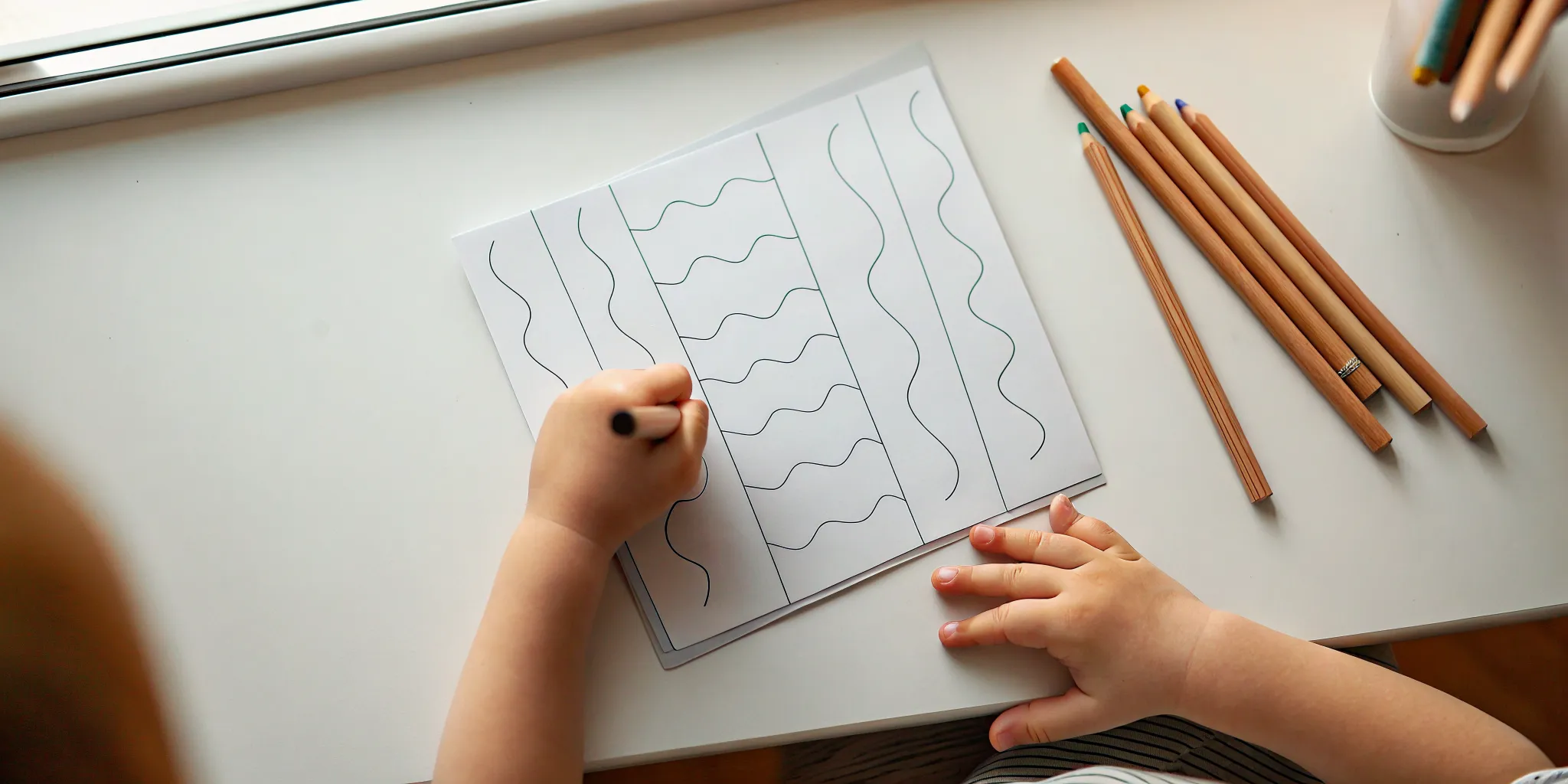
Try a simple warm-up. Ask the child to draw a row of relaxed waves, loops, and gentle curves. Watch the movement rather than the beauty of the result. If the child can repeat the patterns without becoming tense, introductory cursive strokes may be appropriate. If the exercise feels exhausting, return to playful Early Learning activities and try again later.
Look for learning readiness
A child should be able to recognize letters and form most basic print shapes without needing a model every time. This familiarity frees attention for a new movement system. The child should also be able to follow a short sequence, such as start at the baseline, curve up, return down, and connect forward.
Motivation is a valuable clue. A child who asks to learn a signature or copy a grandparent's handwriting is offering a meaningful reason to practice. Use that interest. Begin with the child's name, favorite animal, or a short note rather than an abstract page of repeated letters. Grooved Learning's guide to the benefits and uses of cursive handwriting can help parents frame the skill as a useful new option.
Make the next step enjoyable with Grooved Learning's guided cursive practice.
A flexible Early Learning to Cursive progression
A strong home progression begins with playful Early Learning activities, moves into recognizable print, and adds cursive after the child has basic control and confidence. Each stage can overlap with the next. Keep sessions short, revisit earlier skills when needed, and let practical writing show whether a skill is becoming automatic.
Use this seven-step sequence
- Build hand readiness through play. Use clay, tongs, drawing, finger tracing, and simple mazes to develop control without demanding formal handwriting.
- Teach basic stroke directions. Practice lines, circles, curves, and diagonal movements. Use clear language so the child can describe what the hand is doing.
- Introduce print letters. Group letters with similar movements and model each one slowly. Prioritize a consistent starting point over perfect appearance.
- Practice print in meaningful words. Write names, labels, short lists, and notes. This helps the child see handwriting as communication rather than a worksheet exercise.
- Add introductory cursive patterns. Begin with loops, waves, and related lowercase letters. Teach one manageable group at a time.
- Connect cursive letters into short words. Slow down at joins and check that each finished word remains readable.
- Use both styles for real tasks. Invite the child to choose print or cursive, then discuss which style felt clearer and more comfortable.
Allow overlap instead of demanding mastery
Parents sometimes wait for flawless print before introducing cursive. That standard can delay an exciting new skill and make handwriting feel like a test. A child can continue improving print while beginning simple cursive patterns. The important question is whether the new material is manageable, not whether the previous stage is perfect.
At the same time, do not skip foundational work just because cursive looks interesting. The progression should remain Early Learning to Cursive: first build control and letter familiarity, then develop connected writing. This sequence gives the child a stable base without treating age or grade level as an inflexible deadline.
Measure progress in useful ways
Compare a child's work with that child's earlier work, not with a sibling's page or an idealized font. Look for a looser grip, more consistent letter size, clearer word spaces, fewer pauses, and greater willingness to write. Those changes often matter more than decorative neatness.
Once every few weeks, save a short sample in both print and cursive. Ask the child which felt easier and whether anything hurt. This creates a simple record and gives the child a voice in the process. Grooved Learning's grooved writing approach can provide tactile guidance while those movements become more familiar.
How can parents practice both styles without overwhelm?
Keep handwriting practice brief, specific, and connected to a real purpose. One small goal per session is enough. Model the movement, let the child try, and stop before fatigue causes sloppy repetition. Alternate structured practice with useful writing, and adjust the tool, posture, or task whenever frustration becomes the main experience.
Choose one goal for each session
A ten-minute session should not attempt letter formation, spacing, speed, spelling, and creative writing all at once. Pick one priority. On Monday, the goal might be relaxed print circles. On Tuesday, it might be joining two cursive letters clearly. Narrow goals make feedback easier to hear and success easier to notice.
Begin by showing the movement once or twice. Then let the child complete a small number of careful attempts. More repetition is not automatically better. Repeating an uncomfortable or incorrect movement can reinforce the very habit you want to change. Grooved Learning's reusable materials make it easy to practice a few thoughtful examples and return another day.
Make handwriting useful
Worksheets can teach a movement, but real writing gives the movement a reason. Invite a child to print labels for toy bins, write a grocery item, make a birthday card, or add a caption to a drawing. For cursive, try signatures, short thank-you notes, family names, or a one-sentence journal entry.
Offer choices within a clear boundary: "Would you like to print the list or write it in cursive?" This preserves the practice goal while giving the child control. If the child chooses one style every time, that is useful information. Continue teaching both, but spend extra time understanding what makes the less-preferred style uncomfortable.
Respond to struggle with observation
When writing becomes difficult, avoid vague reminders such as "Be neater." Instead, observe what is happening. Is the pencil slipping? Is the line spacing too narrow? Is the child leaning close to the page? Does the hand ache after two minutes? A specific problem has a specific next step.
Try changing one variable at a time. Use a shorter pencil, larger writing lines, a slanted surface, or fewer words. If the child becomes upset, stop and preserve the relationship. Persistent pain, severe fatigue, or difficulty that affects school participation deserves a conversation with the child's teacher and an appropriate qualified professional.
Find Grooved Learning handwriting resources that meet your child at the right stage.
Which style is better for legibility, speed, and confidence?
Neither print nor cursive is universally better. Legibility, speed, and confidence depend on instruction, practice, comfort, and the task. Some children write clearer print, while others develop a smoother cursive rhythm. Teach both as options, then help the child strengthen the style that supports readable, efficient, comfortable writing.
Legibility comes before speed
A fast page is not useful if the writer or reader cannot understand it. Before encouraging speed, check a few fundamentals: recognizable forms, stable size, clear word spacing, and a comfortable writing rhythm. Once those features are consistent, speed often improves naturally through meaningful use.
Print may remain the clearest choice for boxes, forms, diagrams, or situations where letters must stand alone. Cursive may feel efficient for notes and longer personal writing. Many capable adults switch styles depending on context. Children can learn to do the same without being told that one choice is inherently superior.
Confidence grows from achievable practice
Children notice when handwriting is treated only as a weakness. Balance corrections with accurate observations: "Those three words have clear spaces," or "Your hand stayed relaxed through the whole line." Specific praise shows the child what to repeat. It also makes instruction more credible than broad praise that ignores genuine difficulty.
Frequently Asked Questions
Should children learn print or cursive first?
Most children learn print first because it resembles the text they see and allows them to practice letters individually. Cursive can follow once basic formation and pencil control are comfortable. However, readiness matters more than a strict age, and some children may enjoy introductory cursive patterns while still improving print.
At what age should a child start cursive?
There is no universal starting age. Look for recognizable print, steady pencil control, enough stamina for a short session, and interest in connected writing. If cursive causes tension or distress, return to easier movement practice and try again later.
Is cursive faster than print for every child?
No. Cursive can become fast because many letters connect, but speed depends on the individual writer's comfort and fluency. Some children print more efficiently. Readability and ease should come before speed in either style.
What should parents do when handwriting practice causes frustration?
Stop before frustration escalates, then identify the specific source of difficulty. Shorten the task, enlarge the lines, adjust posture or tools, and focus on one movement. If pain, fatigue, or serious difficulty persists and affects daily participation, consult the child's teacher and an appropriate qualified professional.

Written by
Jenna ColemanJenna Coleman is the founder of Grooved Learning, a former classroom teacher, M.Ed., and mom of three based in Pennsylvania. She creates hands-on, multi-sensory educational tools grounded in the Science of Reading. Every article is written from real classroom and parenting experience.
Learn more about Jenna →


