


Orton-Gillingham Homeschool Curriculum Buying Guide
Choosing a reading program by its label alone can leave crucial skill gaps. Families need a resource that teaches reading and spelling together, fits daily life, and shows exactly how each lesson builds on the last.
Shop Code Breakers for hands-on reading and spelling support.
An Orton-Gillingham homeschool curriculum should teach reading and spelling through explicit, systematic lessons that build from sounds and letters to larger word patterns. Look for purposeful multisensory practice that engages sight, sound, touch, and movement, plus frequent review and a clear, skill-by-skill scope and sequence. The strongest resources also help you identify a child's starting point, adjust the pace, and teach confidently at home without hours of preparation. They connect decoding with spelling and writing, while giving children meaningful ways to hear, trace, build, read, and write new patterns. Before buying, compare lesson guidance, included materials, practice options, parent support, and how well each resource matches your child's current needs.
The right choice starts with knowing what the label should mean, then checking whether the actual lessons live up to it. Next comes the foundational question: What is an Orton-Gillingham homeschool curriculum? That distinction makes every later buying decision clearer, and the path begins with
What is an Orton-Gillingham homeschool curriculum?
An Orton-Gillingham homeschool curriculum is a home-friendly plan for teaching how spoken sounds connect with written letters and patterns. It brings reading and spelling together, so a child learns one idea and then uses it in both directions. The approach gives the adult a clear path for what to teach next.
A clear teaching sequence
In practical terms, lessons follow a planned sequence. New skills build on skills the child has already practiced. The parent teaches each idea directly, models how it works, and checks for understanding before moving forward. This structure makes it easier to notice where a child needs more review.
A useful curriculum does not simply offer a stack of phonics activities. It explains the order of instruction and gives the parent clear lesson steps. Federal reading guidance also calls for teaching sound-letter links and word reading through planned, direct instruction. That guidance helps families tell the difference between a complete plan and a set of extras.
Reading and spelling together
OG-aligned teaching connects the skills children use to read a word with the skills they use to spell it. A child may hear a sound, say it, trace its spelling, build a word, read that word, and write it. Each action supports the same lesson goal.
This link matters because reading and spelling should not feel like separate subjects. The same sound pattern can move from a sound card to a word list, sentence, or short passage. An Code Breakers workbooks can help parents keep those parts connected during home lessons.
What multisensory means at home
Multisensory instruction uses more than one way to practice a skill. A child might say a sound while tracing its letter pattern, then use that pattern to read and spell words. The movement is tied to the lesson, not added only to make the activity seem fun.
- Structured: Lessons follow a clear plan instead of jumping between unrelated skills.
- Explicit: The adult teaches the idea clearly rather than expecting the child to infer it.
- Sequential: Each new skill rests on earlier learning and includes review.
- Multisensory: Children connect what they see, hear, say, touch, and write.
- Connected: Reading, spelling, and handwriting practice reinforce the same pattern.
For homeschool parents, the strongest fit is a plan that is easy to teach and flexible enough for review. It should show what to say, what the child should do, and how to respond when a skill is not secure. That keeps instruction calm, useful, and centered on the child's next step.
What should you look for before you buy?
An Orton-Gillingham homeschool curriculum should give you more than a full box of lessons. It should show you what to teach, when to teach it, and how to respond when your child needs more practice. Before buying, look past the number of pages and check how the program builds skills.
A clear, systematic teaching path
Start with the scope and sequence. Strong programs teach skills in a planned order, moving from simple patterns to more complex ones. New ideas should build on skills your child has already learned. The sequence should also leave room to slow down without losing your place.
Look for explicit lesson scripts or clear teaching notes. You should not have to infer the lesson goal from a worksheet. The program should explain how to model each skill, guide practice, check understanding, and correct errors in a calm way.
- A clear starting point or placement check
- Lessons that follow a logical skill sequence
- Direct teaching before independent work
- Guidance for review, correction, and extra practice
The sequence should cover phonemic awareness, phonics, spelling, and reading as connected skills. It should teach a child to hear sounds, link them to letters, blend them into words, and spell those words. The Foundational Skills practice guide also stresses sound awareness and decoding within early reading instruction.
Enough depth for reading and spelling
Check whether the curriculum teaches more than basic letter sounds. A useful program explains common spelling patterns, syllable types, and ways to read longer words. It should help children understand why words work as they do, rather than ask them to recall each word as a whole.
Review matters just as much as the first lesson. Skills should return across later lessons, with chances to read, spell, write, and say what was learned. This spaced practice helps you see whether a child can use a skill outside the lesson where it first appeared.
- Practice with sounds before and alongside print
- Reading and spelling taught together
- Direct teaching of syllable types and word parts
- Frequent review using both new and known words
- Short checks that guide the next lesson
Materials should also support more than one sense without adding clutter. For example, children may say a sound, trace a pattern, and write it while listening. Tactile tools such as tactile sound practice cards can make that practice easier to repeat at home.
A realistic fit for your homeschool
A strong curriculum only helps if your family can use it with care and consistency. Check the lesson length, prep time, supply list, and teaching directions. Samples should let you see whether the language feels clear before you commit to the full program.
Also ask how the program helps you adjust instruction. Can you pause for review, repeat a skill in a new way, or move ahead when your child is ready? An Code Breakers reading and spelling system should keep the adult central while making each next step easy to understand.
Finally, choose materials that fit your child's age, current skills, and comfort with reading. A simple, well-paced plan often serves a family better than a large program with unclear directions. The goal is steady instruction that builds skill, confidence, and a useful routine.
Why multisensory practice matters at home
Multisensory practice brings sight, sound, touch, and movement into the same short lesson. Instead of asking a child to remember a letter pattern from sight alone, it gives them several clear ways to work with it. These channels are teaching tools, not fixed learning types.
This approach fits an Orton-Gillingham homeschool curriculum because it keeps reading, spelling, and handwriting connected. The National Institute of Child Health and Human Development describes reading instruction as a direct, systematic process. At home, multisensory tools can make that clear instruction more concrete and active.
Four channels working together
A child might look at a letter, say its sound, trace its shape, and move a marker while blending. Each action points back to the same skill. The goal is not to add more activities. It is to make each part of practice purposeful.
- Visual: The child sees a letter, sound pattern, color cue, or blending bar.
- Auditory: The child hears the sound, then says it aloud with an adult.
- Tactile: The child traces a grooved letter and feels where the stroke should travel.
- Kinesthetic: The child uses hand or arm movement while forming, segmenting, or blending.
These channels can appear in one simple routine. For example, a child can trace a sound card while saying the sound. They can then slide a finger across a blending bar as they join sounds into a word.
Tools with a clear teaching job
Useful materials should help the child notice something specific. Tactile tracing draws attention to letter formation. Color-coded blending bars show where sounds join. A mouth formation mirror lets a child watch the lips and tongue while making a sound.
Those tools work best when they support a planned sequence, rather than becoming separate games. Grooved Learning's hands-on sound cards combine grooved tracing, blending bars, and a mirror in one set. A parent can choose the tool that matches the skill being taught that day.
The adult's role in practice
Multisensory does not mean independent. An adult still models the sound or movement, watches the child try it, and gives calm feedback. This guidance helps keep practice accurate and focused, especially when a skill is new.
Start with one clear prompt, such as, "Trace the letter and say the sound." Then ask the child to use the same sound in a blend or word. The hands-on Code Breakers lessons offers a structured setting for this kind of guided practice.
Keep the pace steady and watch the child's response. If the child seems unsure, return to the model and reduce the number of steps. If the child is ready, connect the sound to spelling or handwriting. The point is thoughtful practice with an adult, not a race through materials.
Orton-Gillingham homeschool curriculum features compared
Not every Orton-Gillingham homeschool curriculum packages instruction in the same way. A strong fit gives the parent a clear teaching path while helping the child connect sounds, print, speech, and writing. Compare how each feature works during a real week, not just whether it appears on a product list.
A balanced lesson framework
Scripted lessons reduce planning because they tell parents what to model, say, ask, and review. They should still leave room to slow down or repeat a skill when a child needs it. A useful script explains why an activity matters, so the parent can teach with purpose instead of only reading directions.
The National Reading Panel found that systematic phonics instruction helps children learn to read more effectively. A planned sequence matters. Look for review that returns to older skills before new content is added.
| Feature | What it does | Why families may need it |
|---|---|---|
| Scripted lesson | Sets a clear teaching sequence | Reduces planning and supports consistent instruction |
| Sound cards | Links speech sounds with spelling patterns | Gives the child a concrete prompt for practice |
| Blending practice | Builds words by joining sounds | Helps the child move from parts to whole words |
| Syllable work | Breaks longer words into useful parts | Supports reading and spelling beyond short words |
| Reusable writing practice | Connects sounds, spelling, and handwriting | Allows extra practice without adding new pages |
| Parent support | Explains teaching moves and error correction | Helps adults teach with more confidence |
| Review | Returns to skills after first instruction | Shows what is secure and what needs more work |
Connections between reading skills
Sound cards give a child a concrete way to connect a spoken sound with its spelling. Some cards add touch or movement, which can make practice more active. The goal is not to collect materials; it is to use each tool within a clear lesson.
Grooved Learning's sound cards for blending practice offer one example of tactile sound work designed for repeated home use. Blending practice then asks the child to join sounds and read a whole word. Syllable work gives readers a plan for breaking longer words into manageable parts.
Writing, review, and parent support
Reading and spelling grow stronger when the child also writes the patterns being taught. Reusable writing practice can make that step easier to repeat. This may help when a learner needs more time with letter forms or spelling. Choose materials that keep writing tied to the current sound or word pattern.
Parent support matters just as much as the student pages. Look for lesson notes, clear examples, progress checks, and guidance for correcting mistakes. The right Code Breakers homeschool literacy tools should help a parent see what to teach next and when to review. That clarity makes steady instruction easier to sustain across a busy homeschool week.
How Code Breakers supports homeschool reading and spelling
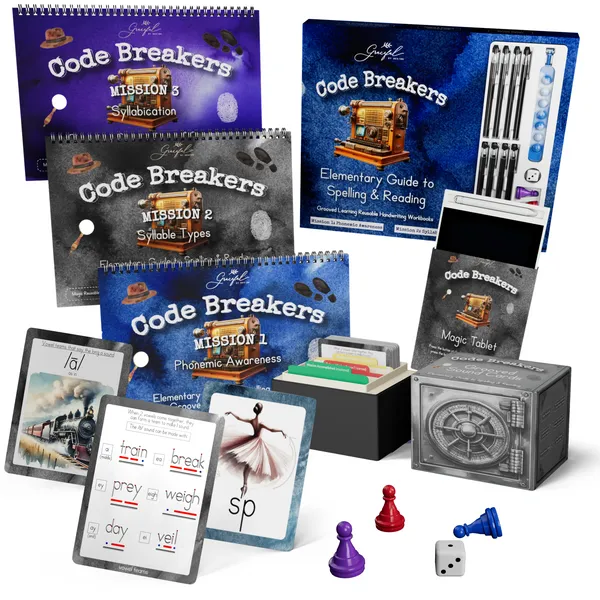
Code Breakers supports homeschool reading and spelling by giving parents a structured, tactile path from phonemic awareness to syllables and longer words. The workbooks, sound cards, reusable writing tools, and guided practice help children see, hear, feel, read, and write the same pattern in one connected routine.
A clear path from sounds to syllables
Code Breakers gives families a tactile, step-by-step way to teach reading and spelling at home. The system follows Science of Reading and Orton-Gillingham principles. Its direct teaching links speech sounds, letters, and movement. This approach reflects the broader research base behind explicit reading instruction, while keeping the parent central to each lesson.
The sequence starts with Mission 1, which builds phonemic awareness. Children learn to hear, separate, blend, and work with the sounds in spoken words. Mission 2 then introduces the six syllable types, giving learners useful patterns for reading and spelling. Mission 3 moves into syllabication. Children learn to break longer words into parts and read them with less guesswork.
This order helps a homeschool parent know what to teach next. It also makes the Code Breakers program easier to use as a core program or as extra support. Families can slow down, repeat a lesson, or move ahead when a child is ready.
Tools that make each lesson hands-on
Code Breakers workbooks guide the teaching sequence, but children do more than fill in a page. Magic Pens and the Magic Tablet add reusable writing practice. Pop-it tools bring touch and movement into sound work, blending, and word building. These tools make an idea concrete before a child applies it in print.
- Magic Pens and Magic Tablet: Support repeated writing, spelling, and word-building practice.
- Pop-it tools: Give children a simple way to mark, count, and blend sounds.
- Digital Mission Hub: Adds guided digital support that follows the mission sequence.
- Workbooks: Keep lessons organized and give parents a clear path through each skill.
The Digital Mission Hub can extend a lesson without replacing the adult who teaches it. A parent can introduce a skill in the workbook, add a pop-it activity, then use the hub for more practice. This mix keeps lessons varied while the reading and spelling goal stays clear.
Sound Cards for seeing, feeling, and hearing
The Code Breakers Sound Cards add another tactile layer to daily practice. The set includes 180 grooved cards, color-coded blending bars, and a mirror. Children can trace a spelling pattern, say its sound, and use the bars to blend it with other sounds. The mirror helps them watch how their mouth forms a sound.
Families can use the sound cards for spelling routines for quick reviews, word building, or focused practice with a hard pattern. The cards also connect reading and spelling in one task. A child can hear a sound, find its card, trace it, blend it, and then write the word.
Together, the missions and tactile tools create a practical Orton-Gillingham homeschool curriculum routine. Each lesson can include listening, speaking, touching, reading, and writing. That gives families several ways to practice the same skill while keeping instruction clear, calm, and manageable.
Explore the Code Breakers Bundle for a ready-to-use homeschool routine.
How do you start using it without overwhelm?
Start by choosing one skill sequence, one short daily routine, and one clear way to track what your child can do independently. A manageable Orton-Gillingham homeschool curriculum should reduce planning, not add pressure, by showing the adult what to model, practice, review, and adjust next.
Start smaller than you think you need to. An Orton-Gillingham homeschool curriculum works best when the lessons follow a clear sequence and respond to your child's progress. The National Reading Panel findings support systematic phonics instruction, which teaches sound and letter patterns in a planned order.
You do not need a perfect school-day schedule or a shelf full of materials. Choose one clear starting point, teach for a short time, and watch how your child responds. That steady approach keeps the adult central while giving the child room to build skill and confidence.
A simple five-step start
- Notice the current need. Listen as your child reads and spells. Note whether the main challenge involves hearing sounds, matching sounds to letters, blending, reading smoothly, or spelling patterns.
- Choose the next clear sequence. Begin with the earliest skill that is not yet secure, rather than jumping to grade-level work. A well-planned sequence reviews known patterns before adding one new idea.
- Gather a few useful tools. Keep paper, a pencil, letter tiles, and something tactile within reach. An Code Breakers tactile literacy system can reduce planning because the sequence and hands-on practice are already connected.
- Set a short routine. Pick a calm part of the day and use the same basic lesson flow. Review a known pattern, teach one new point, practice reading and spelling, then end with success.
- Observe and adjust. Record one brief note after each lesson. If your child is accurate and calm, move forward; if errors repeat, slow down and offer more guided practice.
What to keep nearby
A small basket can hold everything needed for the routine. Include the lesson guide, writing tools, letter tiles, and a short reading passage. Add Code Breakers Sound Cards when your child needs help linking a sound with its written pattern.
Keep the first week focused on learning the routine, not racing through lessons. Aim for calm, focused practice that ends before attention fades. If a task causes strain, shorten it or return to a known pattern before trying again.
Review your notes after several lessons. Look for patterns instead of judging one hard day. A child who reads a pattern but cannot spell it may need more dictation, while a child who guesses may need slower blending practice.
Progress does not need to look fast to be useful. A manageable routine makes it easier to stay consistent, notice growth, and choose the next step with care.
Common mistakes when choosing a homeschool reading program
The most common buying mistakes are choosing too many materials at once, mistaking colorful activities for explicit instruction, skipping spelling and handwriting connections, and expecting one program to replace active teaching. A better choice gives you a clear sequence, purposeful review, and realistic daily use.
Too much, too soon
A large program can look complete, yet too many parts may make daily lessons hard to sustain. Start with the child's clearest need and a routine your family can repeat. You can add materials after the core lessons feel steady.
Another common mistake is choosing an Orton-Gillingham homeschool curriculum that mentions phonics but does not teach skills in a clear order. Look for direct teaching, guided practice, review, and a way to check understanding. The National Reading Panel report explains the value of systematic phonics instruction within a full reading program.
Missing links across literacy skills
Reading should not sit in a separate box from spelling and handwriting. Children need chances to hear a sound, connect it to letters, spell it, and write it. Skipping those links can make a program feel less clear and harder to use.
Before buying, check whether lessons connect decoding, spelling, writing, and review. An Code Breakers curriculum support can show how those skills work together through hands-on practice. This does not mean purchasing every add-on at once.
Relying only on screens can also narrow the lesson. Digital tools may help with planning or extra practice, but children also benefit from working with sounds, letters, and written words. Choose a mix that keeps the adult involved and lets the child respond in more than one way.
Realistic progress and daily fit
It is easy to expect instant results from a new curriculum. Reading growth often takes steady teaching, useful review, and time. A slow week does not always mean the program is wrong, and a quick start does not remove the need for review.
- Do not buy several full programs before testing one clear routine.
- Do not confuse colorful activities with explicit, ordered instruction.
- Do not skip spelling, handwriting, or hands-on practice without a clear reason.
- Do not expect one tool to replace active teaching and observation.
Watch how the child responds during lessons. Note which skills are secure, where errors repeat, and how much support is needed. These observations help you adjust pace or practice without changing programs at every hard moment.
Add Code Breakers Sound Cards for tactile sound, blending, and spelling practice.
Frequently Asked Questions
Can parents use an Orton-Gillingham homeschool curriculum without specialized training?
Yes, many parents can use an Orton-Gillingham-aligned resource at home without specialized training. Look for clear lesson directions, a detailed scope and sequence, teaching demonstrations, and built-in review. The resource should explain how to correct errors and adjust pacing. Before purchasing, review a sample lesson to confirm that its instructions feel manageable.
How do I choose the right starting level for my child?
Choose a starting level based on demonstrated reading and spelling skills, not age or grade alone. Use the publisher's placement assessment, then compare the result with recent reading and writing samples. Begin before the first skill that remains uncertain. Starting slightly earlier can provide useful review, while starting too far ahead may leave important gaps.
Does a child need a dyslexia diagnosis to use an Orton-Gillingham-aligned resource?
No, a child does not need a dyslexia diagnosis to use an Orton-Gillingham-aligned reading and spelling resource. Its explicit, sequential, and multisensory instruction can support many learners who need clearer practice. However, persistent reading difficulties may warrant an evaluation by a qualified professional. A curriculum supports instruction, but it does not diagnose learning differences.
How much time should homeschool families spend on Orton-Gillingham lessons?
There is no single lesson length that fits every child or curriculum. Ask the publisher about expected teaching time, preparation, and weekly frequency before buying. Choose a schedule your family can follow consistently, and watch the child's accuracy, attention, and fatigue. Shorter focused lessons may be more useful than longer sessions when a learner becomes overwhelmed.
Is an Orton-Gillingham homeschool curriculum a complete language arts program?
Not always. Some Orton-Gillingham-aligned resources focus mainly on phonemic awareness, phonics, reading, and spelling. Others also address handwriting, vocabulary, fluency, and comprehension. Check the scope and sequence against your homeschool requirements before purchasing. You may need separate resources for grammar, composition, literature, or independent reading, depending on the program's coverage.
Ready to choose a clearer path for reading?
Waiting too long for the perfect curriculum can leave your child repeating lessons that do not match their needs or support steady progress. Without a clear next step, daily practice can become inconsistent, and small frustrations may grow while your homeschool routine gets harder to maintain. Starting now gives you time to build a steady routine, notice what helps, adjust your approach, and prepare for the next learning challenge.
Ready to choose a practical next step for reading and spelling? Shop the Code Breakers collection to begin a consistent, hands-on routine that keeps you involved and gives your child focused practice from the first lesson. Start with one manageable lesson, then build from there.

Written by
Jenna ColemanJenna Coleman is the founder of Grooved Learning, a former classroom teacher, M.Ed., and mom of three based in Pennsylvania. She creates hands-on, multi-sensory educational tools grounded in the Science of Reading. Every article is written from real classroom and parenting experience.
Learn more about Jenna →


